BMW 507 Versions
One body, one engine size and two series: the show and test cars of 1955, the Series I of 1956–57, the Series II that followed BMW's changes of June 1957, the factory hardtop BMW called the Coupé-Aufsatz, the late front discs and the one-off cars built on 507 chassis. BMW called every one the 507 Touring Sport.
BMW built the 507 with one body, one engine size and one specification for every market, and every car had its steering on the left. What changed over its life was the detail. In June 1957 BMW reworked the tank, the dashboard and the space inside, which divides the cars into a Series I and a Series II; at the very end it offered front disc brakes; and a hardtop was on the extras list throughout. The line-up shows the two series with their production readings.source 1source 2source 3source 4
The factory's name: 507 Touring Sport
BMW's catalogue of 1957 heads its pages on the car "BMW 507 Touring Sport", and the brochures of 1958 and 1959 use the same name; its data sheet describes the body as a two-seater roadster with an all-weather hood (soft top). The French brochure calls it "La voiture BMW 507 Touring Sport", a "cabriolet bi-places". auto motor und sport listed it as the "507 Touring-Sport" in September 1955 and as a "Touring Sport Roadster" in its price lists of 1956 and 1958, and BMW's own advertisement of 1955 announced "Der neue BMW Touring-Sportwagen", the new BMW touring sports car. Motor Sport had its own words: a "sports-roadster" in 1955 and a "sports/tourer" in 1956.source 1source 5source 2source 6source 7source 8source 9source 10
The 1955 show and test cars
The cars shown in 1955 were not yet the cars BMW sold. auto motor und sport's show report gave the 507 a less powerful engine than the production car and five gears, worked by a central lever and synchronised on all but first, with the same three axle ratios BMW later listed and brakes in light-alloy drums with cast-iron rings shrunk in. Jenkinson drove a prototype in Munich that autumn with a five-speed gearbox (transmission) attached directly to the clutch housing. The five-speed cars were the 1955 show and test cars only: from 1957 BMW's catalogue and brochures list a four-speed gearbox flanged to the engine. At Frankfurt, Jenkinson read the car's purpose from its extras list:
That B.M.W. are interested in this car being used for competition is shown by the listed extras which include full-length undertray, cockpit cover for the passenger seat, aero-screen and high rear-axle ratio.
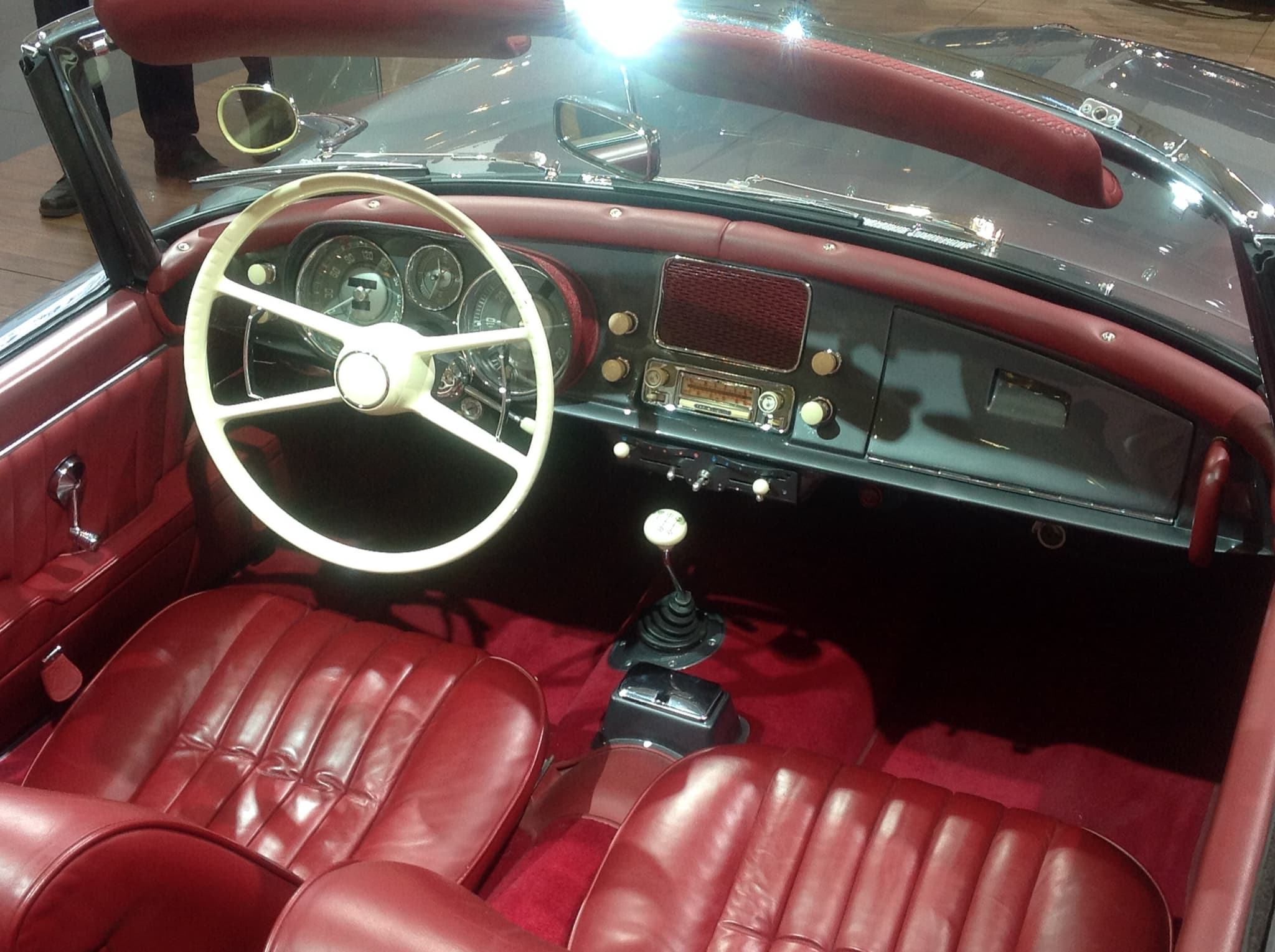
The first chassis numbers went to prototypes. BMW's 2005 account and Lange's research name 70001 as Ernst Loof's car and 70002 as the first with Goertz's body, and Lange, as Bimmer reported it in 2009, adds 70003. The BMW V8 Club lists what changed on the way to the series cars: the white rubber seals round the windows and the hardtop became black, the wipers stopped sweeping in opposition, the screen demister outlets moved to the middle of the dashboard, and the two-tone steering wheel and the dials painted in the dashboard colour were dropped. By the club's account the series engine also gave more power than the pre-launch figures.source 6source 9source 11source 12source 3source 13source 1source 2
Series I and Series II
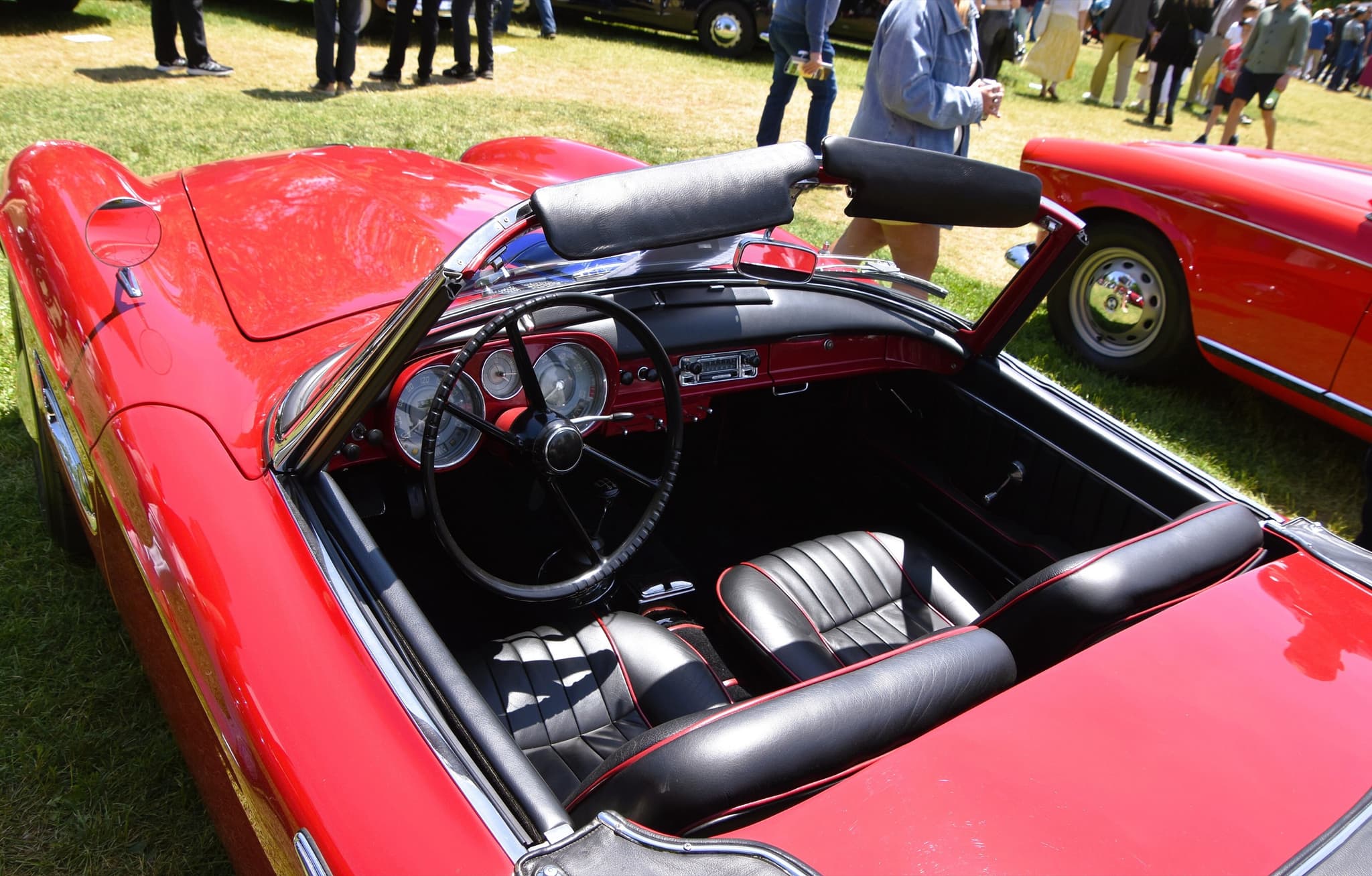
BMW made its changes in June 1957, after the first deliveries (BMW, 2005). The BMW V8 Club's list starts them at chassis 70044. Three counts of the early cars are in print, BMW's deliveries before the change, the club's Series I cars and the figure Bimmer gave in 2013, and the line-up shows all three with their sources. The club says customers had complained that the boot (trunk) was too small and the seats did not slide back far enough, and Bimmer reported in 2013 that some had complained of a fuel smell in the cockpit. In the spring of 1957 Sports Cars Illustrated passed on the American importer's news that the interior had been widened, the dashboard changed and the tank moved beside the spare wheel.
BMW's own account confirms the date, the tank and its new place; the table follows the BMW V8 Club's list for the rest.
| Part | Series I | Series II |
|---|---|---|
| Fuel tank | Aluminium, standing upright behind the seats | Under the boot floor, beside the spare wheel |
| Filler | On top of the tail, behind the folded hood | In the right rear wing (fender) |
| Range on a tankful | 600–700 km (370–435 miles) | 400–500 km (250–310 miles) |
| Dashboard | Goertz's first design | Redrawn, with a loudspeaker and a larger glovebox |
| Luggage in the cockpit | A lockable compartment above the seats, the full width of the car | More room behind the seat backs, in its place |
| Seats | Did not slide back far enough | Longer runners |
| Bumpers | Slimmer, on chromed round tubes | Heavier, on black flat-iron brackets |
| Door handles | The first pattern | Narrower, with a different push button |
| Panel under the rear bumper | Angular, painted black | Rounded |
Later changes and options
The changes went on after the series change. By the BMW V8 Club's list, later in 1957 the cars had new heater hoses and a revised camshaft, and in 1959 the automatic brake adjusters, which BMW's catalogue of 1957 had listed, were dropped.
Front disc brakes came last. Motor Sport's show guide of October 1959 noted that "Disc brakes are available", and Sports Cars Illustrated reported that December that the cars for 1960, in the American sense of the 1960 model year, had Dunlop discs on the front wheels. Von Falkenhausen had tried Jaguar-sized Dunlop discs on all four wheels before he chose the front only, and the magazine drove a pre-production car with them in Europe:
With discs there's no fade at all.
BMW's brochure of 1959 lists only the Alfin drums. The BMW V8 Club believes that at most the last four cars had the discs, and no source read gives the first chassis to have them. The 1960 cars also had their pedals "rearranged to encourage more sporting driving" and redesigned windscreen (windshield) wipers.
The BMW V8 Club also describes a higher-compression engine, which it calls a "USA-Hochverdichtungsmotor", with a sharper camshaft, a richer carburettor setting and colder plugs. BMW's catalogue and brochures of 1957–59 list only the standard engine, and whether the other was an option, an export version or a works tune, no source read says.
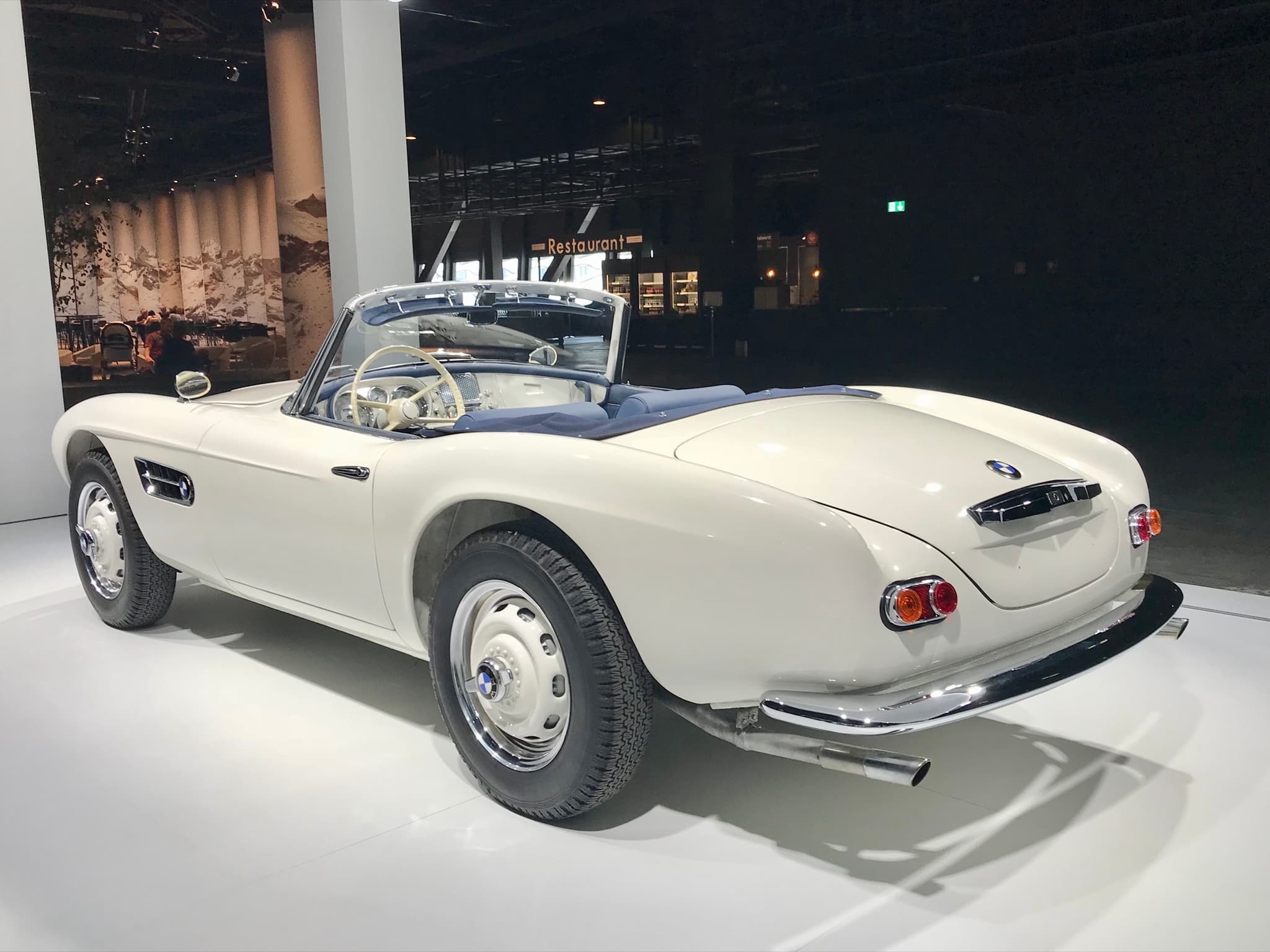
Centre-lock disc wheels, "du type Rudge" in the French brochure, were an extra from 1955 to the end; the car in the picture has them. By December 1959 German law had banned the eared spinners, and BMW replaced them with an octagonal nut and a matching spanner (wrench). The other extras in BMW's catalogue were a Becker radio with automatic station-seeking and an automatic aerial, the two other axle ratios, a reversing lamp, an undertray and sealed-beam headlamps for export. In 1955 the list had also offered a brake servo, later standard, a half-width screen, a cover for the passenger seat, a screen washer and a limited-slip differential, and in 1956 Motor Sport was told that Porsche RS seats could be fitted if required.source 14source 1source 18source 17source 2source 12source 5source 6source 10
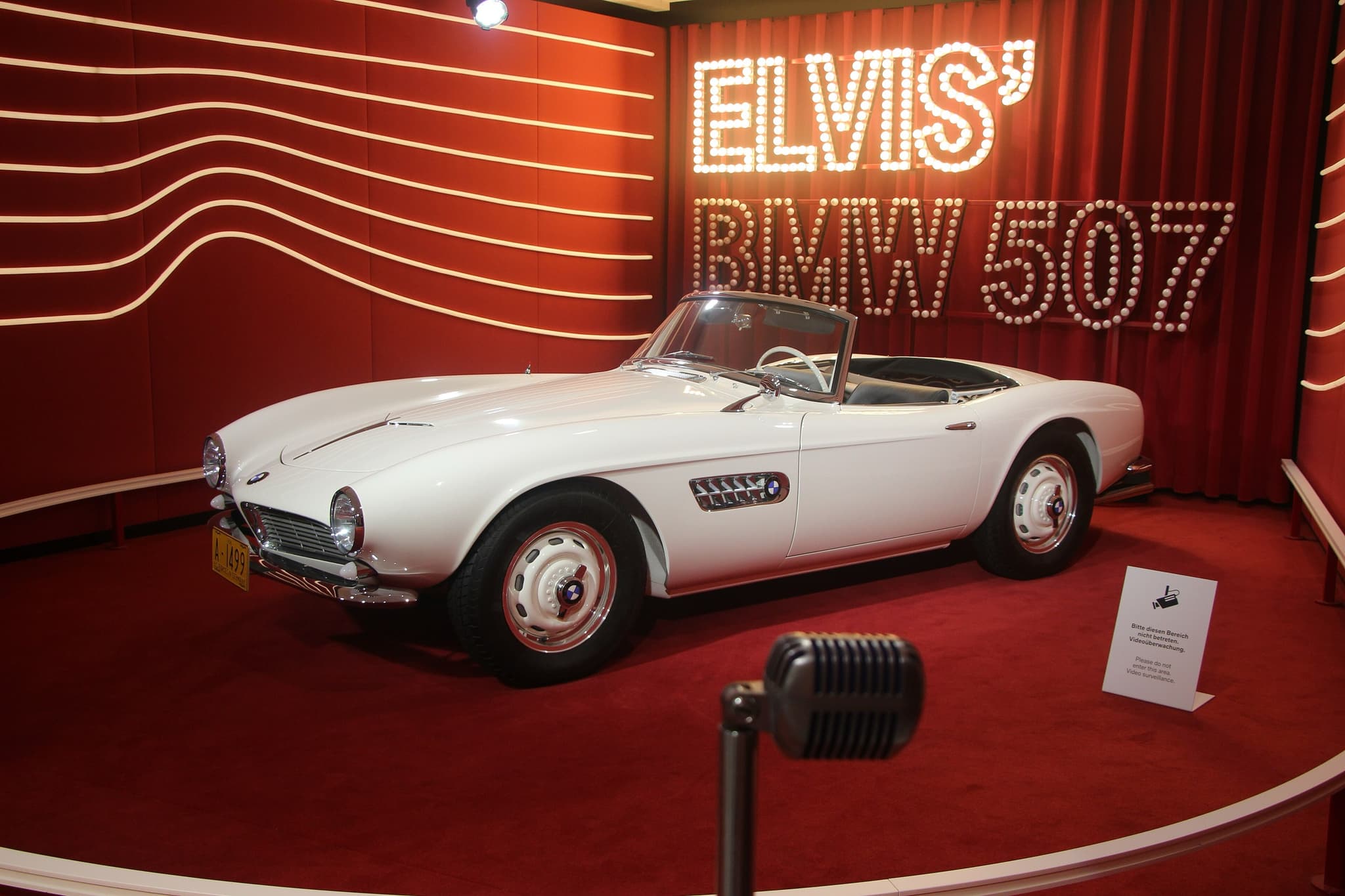
BMW 507 Hardtop
The hardtop was BMW's own, made of aluminium like the body. Jenkinson described it after his visit to the works in 1955:
… a detachable hard-top, held by six, screws and two quick-action clips, is available, and this is made of aluminium, as is the rest of the bodywork, and the result is one of the nicest looking sporting roadsters yet seen.
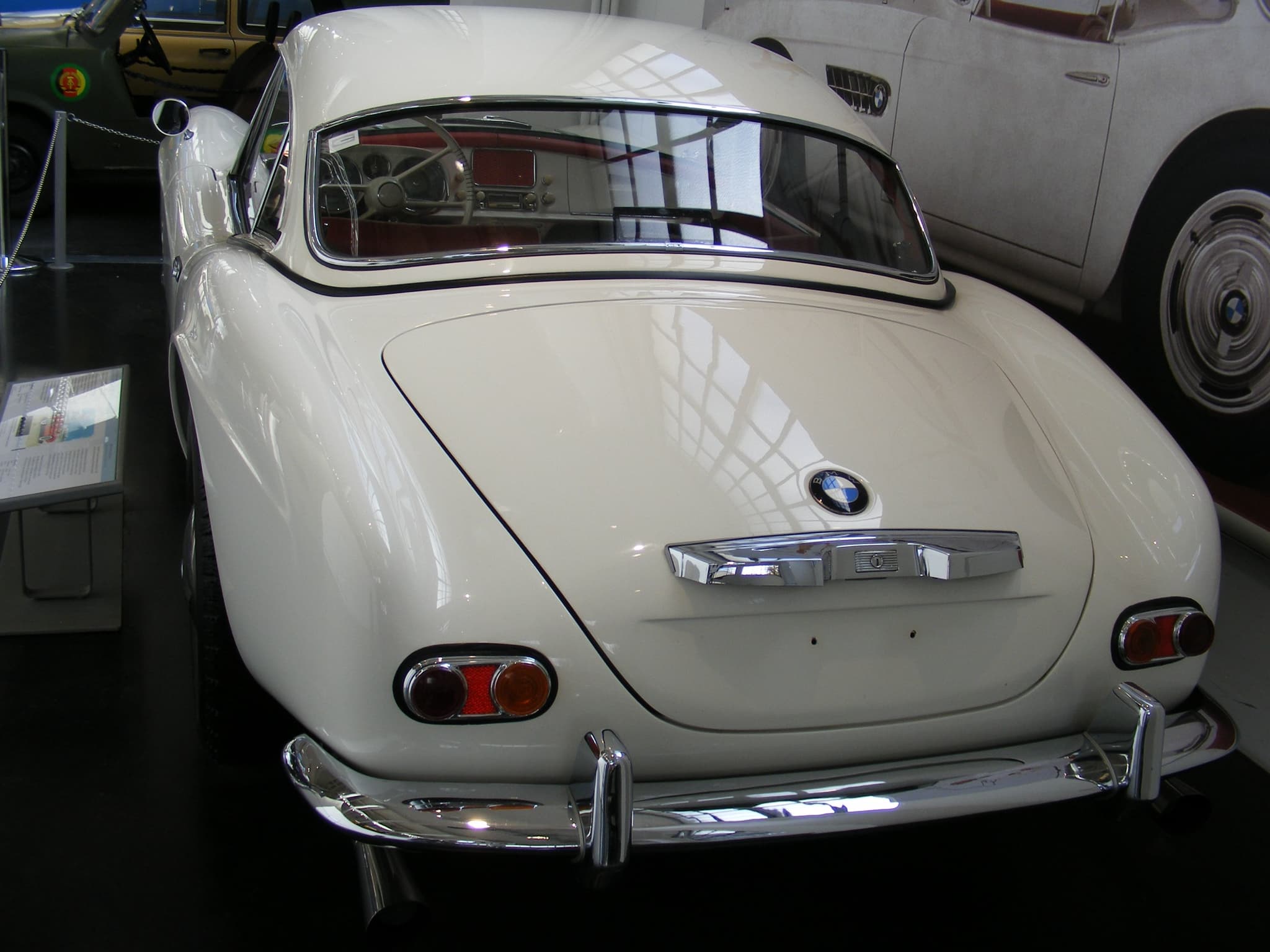
BMW called it the "Coupé-Aufsatz", the coupé top, in its catalogue and brochures, and the price list of September 1958 the "Coupé-Dach"; the French brochure has a "toit amovible". It was always an extra: BMW's advertisement of 1955 lists the "Coupé-Aufsatz als Sonder-Ausstattung", and the French brochure says that as built the car has a folding hood and "sur demande, elle pourra être livrée avec un pavillon en tôle amovible", that it could be delivered with a removable metal top to order. The German price lists of 1956 and 1958 give it a price of its own beside the car's, a higher one by 1958. The white Frankfurt car of 1955 wore one, and on the prototypes the hardtop's seals were white; on series cars they are black.
The hardtop counts in the performance figures. BMW's catalogue and the brochure of 1959 give the car's top speed closed, with the undertray and the 3.42 to 1 axle, while the French brochure gives the same speed with the hood up. When Motor Revue timed a car, as auto motor und sport reported in 1958, it had the "serienmäßigen Coupé-Aufsatz", the production hardtop, in place. Sports Cars Illustrated noted in 1957 that the hardtop could be bolted on without removing the hood, and in 1959 that "the pertinent section in the 80-page instruction manual makes its removal and installation sound a bit tedious". No source read gives the number of hardtops made.source 9source 1source 2source 19source 7source 6source 5source 11source 12source 20source 16source 17
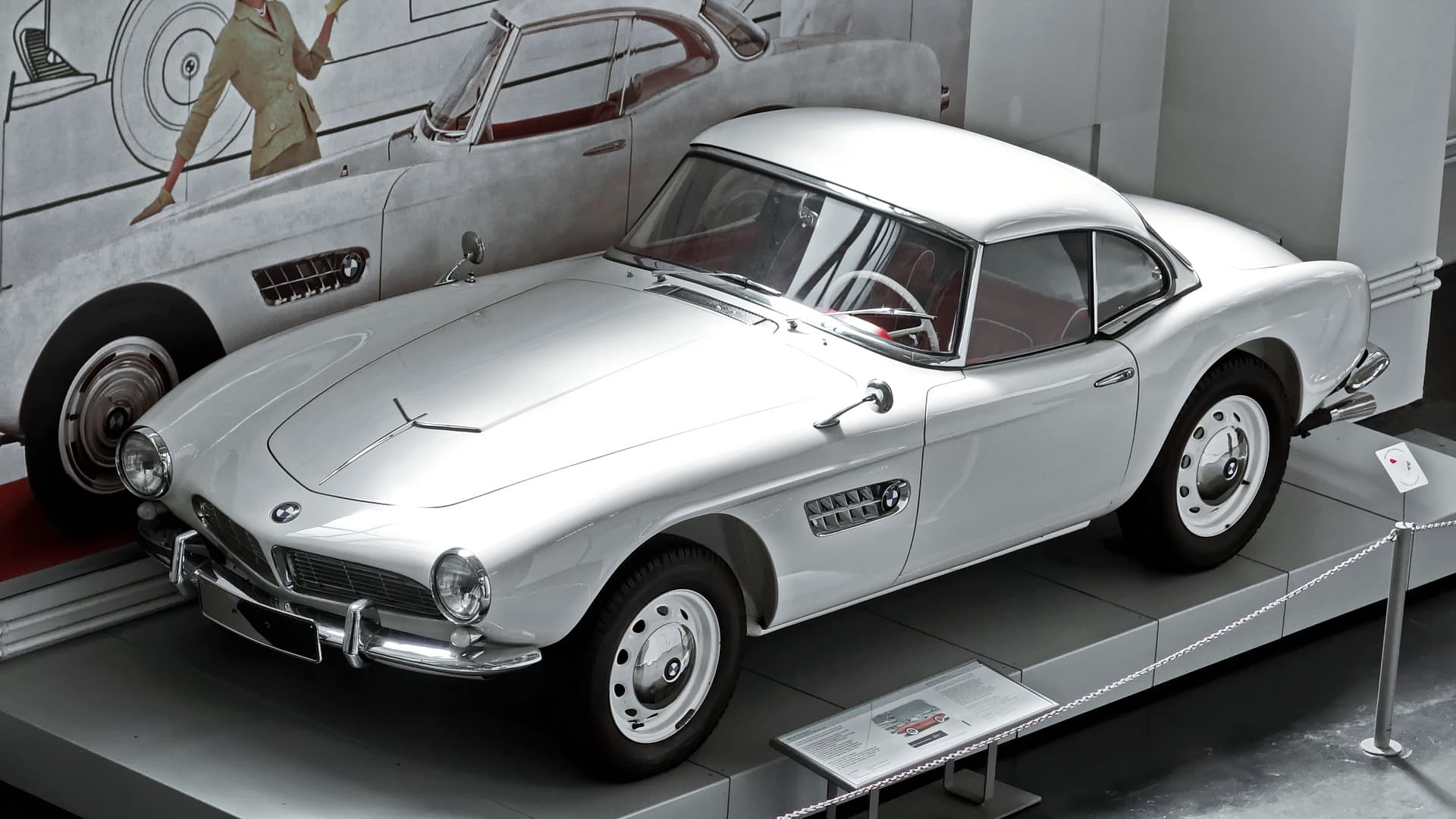
The one-off cars on the 507
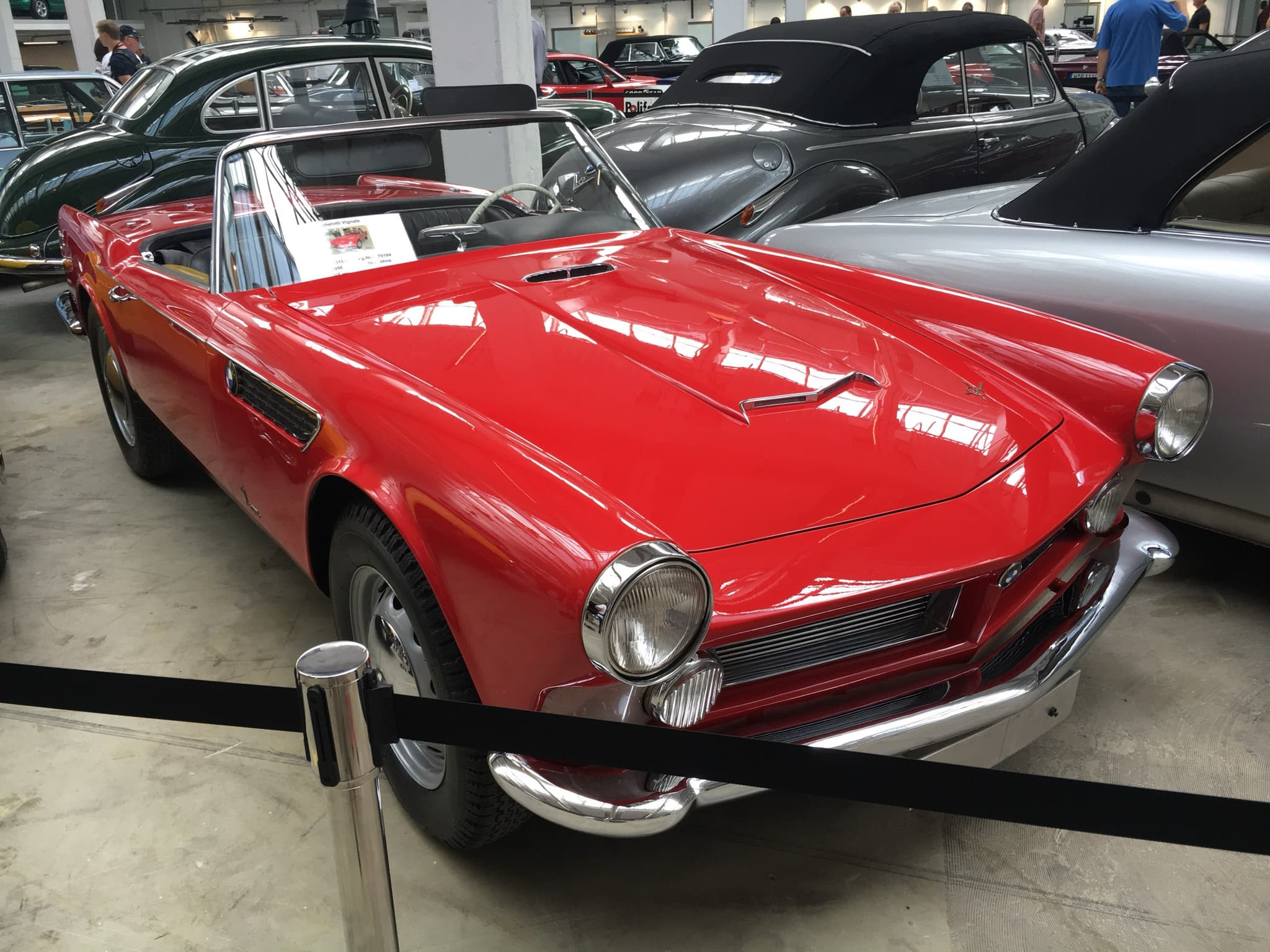
Two famous coachbuilt cars were made on 507 chassis. At the Paris Salon of October 1957 Motor Sport found Raymond Loewy's small cream two-seater coupé on a 507 chassis, built for him by Pichon-Parat of Sens, with a plastic body by BMW's accounts. In 1959 Giovanni Michelotti showed a roadster on chassis 70184, bodied by Scaglietti and assembled at Vignale, which the BMW V8 Club describes as a cabriolet with a hardtop; BMW Group Classic calls it the BMW 3200 Michelotti Vignale. Both cars, and the 507s that famous people owned, are on Notable BMW 507s.source 21source 15source 3source 12source 22
Versions
Sources for Versions
- Series I
- 43 built: BMW V8 Club Deutschland, "Modellübersicht 503 507 3200 CS"source 12
- 45 built: BMW AG (BMW Group PressClub Czech Republic), "Zeitlose Eleganz: 50 Jahre BMW 507 und BMW 503", chapter of the press kit "Legenden der 50er Jahre: BMW 507 – BMW 503 – BMW Isetta", German, Apr 2005source 3
- 34 built: Jackie Jouret and Helmut Werb, "507s star at Pebble Beach", Bimmer, No. 119, 25 Oct 2013source 15
Series I
1956–1957
43 built or 45 or 34
Series II
1957–1959
Sources
Every source the site cites is on the sources page.
- Primarymade at the time, by the maker or by people who were there
- Referenceserious later work: clubs, specialists, magazines, books
- Bayerische Motoren Werke AG, BMW 502 · 503 · 507 (V8 range catalogue), German, 1957, Nr. W 147, the 507 pages: one body and engine; the 507 pages, headed "BMW 507 Touring Sport"; the data sheet's "2sitziger Roadster mit Allwetter-Verdeck"; the four-speed gearbox on the engine; "selbsttätiger Bremsbackennachstellung"; the extras: hardtop, Becker radio, centre-lock wheels, axle ratios, sealed-beam lamps, reversing lamp, undertray; the extras: "abnehmbarer Coupé-Aufsatz"; the top speed "bei geschlossenem Wagen mit Unterschutz". archive.org/details/100_20260601 Primary
- Bayerische Motoren Werke AG, BMW 507 Touring Sport (sales brochure), German, 1/1959, W 61 5 1.59, the data page; the title, "BMW 507 Touring Sport"; the four-speed gearbox; the brakes: Alfin drums; the extras; the extras and the top speed. archive.org/details/1959-bmw-507-touring-sport-brochure.-w-61-5-1.-59-0 Primary
- BMW AG (BMW Group PressClub Czech Republic), "Zeitlose Eleganz: 50 Jahre BMW 507 und BMW 503", chapter of the press kit "Legenden der 50er Jahre: BMW 507 – BMW 503 – BMW Isetta", German, Apr 2005, the changes of June 1957; 70 001 (Loof) and 70 002 (Goertz); "führte BMW im Juni 1957 eine Reihe von detaillierten Änderungen und Verbesserungen ein"; the tank "hinter den Vordersitzen", then "unter dem Kofferraumboden"; Loewy's "Kunststoff-Karosserie"; 507/503 chapter. press.bmwgroup.com/czech/article/attachment/T0066597CS/96056 Primary
- Motor Sport, "The Cars at Earls Court", Nov 1958, p. 22, the BMW stand: left-hand drive only. motorsportmagazine.com/archive/article/november-1958/22/cars-earls-court Primary
- Bayerische Motoren Werke AG, BMW 507 Touring Sport (sales brochure, French), French, 1/1958, W 61 f 5 1.58, the cover and data page: "La voiture BMW 507 Touring Sport", "cabriolet bi-places"; "roues à disque avec fermeture centrale du type Rudge"; "toit amovible"; the quotation on the hood and the removable metal top; the top speed with the hood up. archive.org/details/101_20260417 Primary
- auto motor und sport, IAA report, "Technische Daten der deutschen Personenwagen" and "Preise der deutschen Personenwagen", Heft 20, 24 Sep 1955, the price list and data table: "507 Touring-Sport"; BMW's advertisement, "Der neue BMW Touring-Sportwagen"; the IAA report and data table: five gears with a central lever, all but first synchronised; the axle ratios; the light-alloy drums with cast-iron rings; the 1955 extras: brake servo, half-width screen, passenger-seat cover, screen washer, limited-slip differential; BMW's advertisement: "Coupé-Aufsatz als Sonder-Ausstattung". archive.org/details/auto-motor-und-sport-1955-heft-20 Primary
- auto motor und sport, New-car price list ("Preise"), Heft 6/1956, "507 Touring Sport Roadster"; "hierzu Coupé-Aufsatz". archive.org/details/auto-motor-und-sport-1956-heft-6 Primary
- auto motor und sport, New-car price list ("Preise"), Heft 15, 19 Jul 1958, "[5]07 Touring Sport-Roadster". archive.org/details/auto-motor-und-sport-1958-heft-15 Primary
- Denis Jenkinson ("D.S.J."), "At the House of B.M.W.", Motor Sport, Nov 1955, p. 46, p. 46, "the 507 sports-roadster"; p. 46, the prototype's five-speed gearbox, brakes and axle ratio; p. 46, the quotation. motorsportmagazine.com/archive/article/november-1955/46/at-the-house-of-bmw Primary
- Bill Boddy, "German high performance", Motor Sport, Nov 1956, p. 28, "the 507 sports/tourer"; Porsche RS seats "can be fitted to the 507 if required". motorsportmagazine.com/archive/article/november-1956/28/german-high-performance Primary
- Denis Jenkinson ("D.S.J."), "The Frankfurt Motor Show", Motor Sport, Nov 1955, p. 51, p. 51, the quotation; p. 51, the hardtop on the Frankfurt car. motorsportmagazine.com/archive/article/november-1955/51/the-frankfurt-motor-show Primary
- BMW V8 Club Deutschland, "Modellübersicht 503 507 3200 CS", the prototypes against the series cars; the Series I and Series II: the reasons, the tank, the filler, the dashboard, the luggage space, the seats, the bumpers, the door handles, the rear panel, the range; the discs on "allerhöchstens … die letzten vier" cars; the "USA-Hochverdichtungsmotor"; the prototype's white seals; the Vignale car on 70184, a cabriolet with hardtop; "nach den ersten 43 gebauten Fahrzeugen". bmw-v8-club.de/fahrzeuge/8-zylinder-baureihe/modeluebersicht-503-507-3200-cs.html Reference
- Jackie Jouret, "Elvis' 507: The real story", Bimmer, No. 83, Jun 2009; republished on bimmer-mag.com, 28 Jul 2014, 70003 among the 1955 cars. web.archive.org/web/2016id_/http://www.bimmer-mag.com:80/news-blog/elvis-507-the-real-story Reference
- BMW V8 Club Deutschland, "Technische Daten 503 507 3200CS", the running changes of 1957 from chassis 70044; running changes, 1957–59: heater hoses and camshaft; the automatic brake adjusters dropped in 1959; the higher-compression engine. bmw-v8-club.de/fahrzeuge/8-zylinder-baureihe/techniche-daten-503-507-3200-cs.html Reference
- Jackie Jouret and Helmut Werb, "507s star at Pebble Beach", Bimmer, No. 119, 25 Oct 2013, p. 6, the Series I count; the complaints of fuel smell; pp. 7–9, Loewy's coupé and its plastic body; Michelotti's car on 70184; p. 6. bimmer-mag.com/issues/119/articles/507s-star-at-pebble-beach Reference
- Jesse Alexander, "Complete report on BMW 507", with "Factory test data" and "Late news from BMW", Sports Cars Illustrated, May 1957, pp. 18–21, 50, "Late news from BMW": the interior widened, the dash changed, the tank moved beside the spare; caption, "Hardtop can be bolted on without removing cloth top". archive.org/details/sim_car-and-driver_1957-05_2 Primary
- Sports Cars Illustrated, "Disc-Braked BMW 507" (road test), with the same issue's Frankfurt show report, Dec 1959, pp. 49–51, 104, p. 50, the spare under a false floor and the tank beside it, filled through a door in the right wing; p. 51 caption and p. 104: Dunlop front discs for the 1960 cars, von Falkenhausen's trials, the quotation; the pedals and wipers for 1960; the knock-off ears; p. 104, the instruction manual on the hardtop. archive.org/details/sim_car-and-driver_1959-12_5 Primary
- Motor Sport, "Earls Court Reviewed", Nov 1959, p. 39, BMW 507, stand 122: "Disc brakes are available". motorsportmagazine.com/archive/article/november-1959/39/earls-court-reviewed Primary
- auto motor und sport, New-car price list ("Preise"), with the Motor Revue advertisement, Heft 21, 11 Oct 1958, "Coupé-Dach hierzu". archive.org/details/auto-motor-und-sport-1958-heft-21 Primary
- auto motor und sport, "Wie sie beschleunigen", Heft 4, 15 Feb 1958, the test car "mit dem serienmäßigen Coupé-Aufsatz". archive.org/details/auto-motor-und-sport-1958-heft-4 Primary
- Motor Sport, "The 44th Paris Salon", Nov 1957, p. 21, Loewy's coupé on a 507 chassis, cream, by Pichon-Parat. motorsportmagazine.com/archive/article/november-1957/21/the-44th-paris-salon Primary
- BMW Group Classic (BMW Classic blog), "60 Years of Pure Temptation", 2015, the BMW 3200 Michelotti Vignale. presstopic.bmwgroup.com/en/bmw-classic-blog/text/60-YEARS-OF-PURE-TEMPTATION-4484.html Primary