Built 1954
Ernst Loof's 507 prototype
Survives
The BMW 507s with histories of their own: John Surtees's car, Hans Stuck's works cars on the hill climbs, Raymond Loewy's coupé, Michelotti's one-off, the prototypes, the famous owners graded by the evidence, a film and a stamp, and where the cars can be seen.
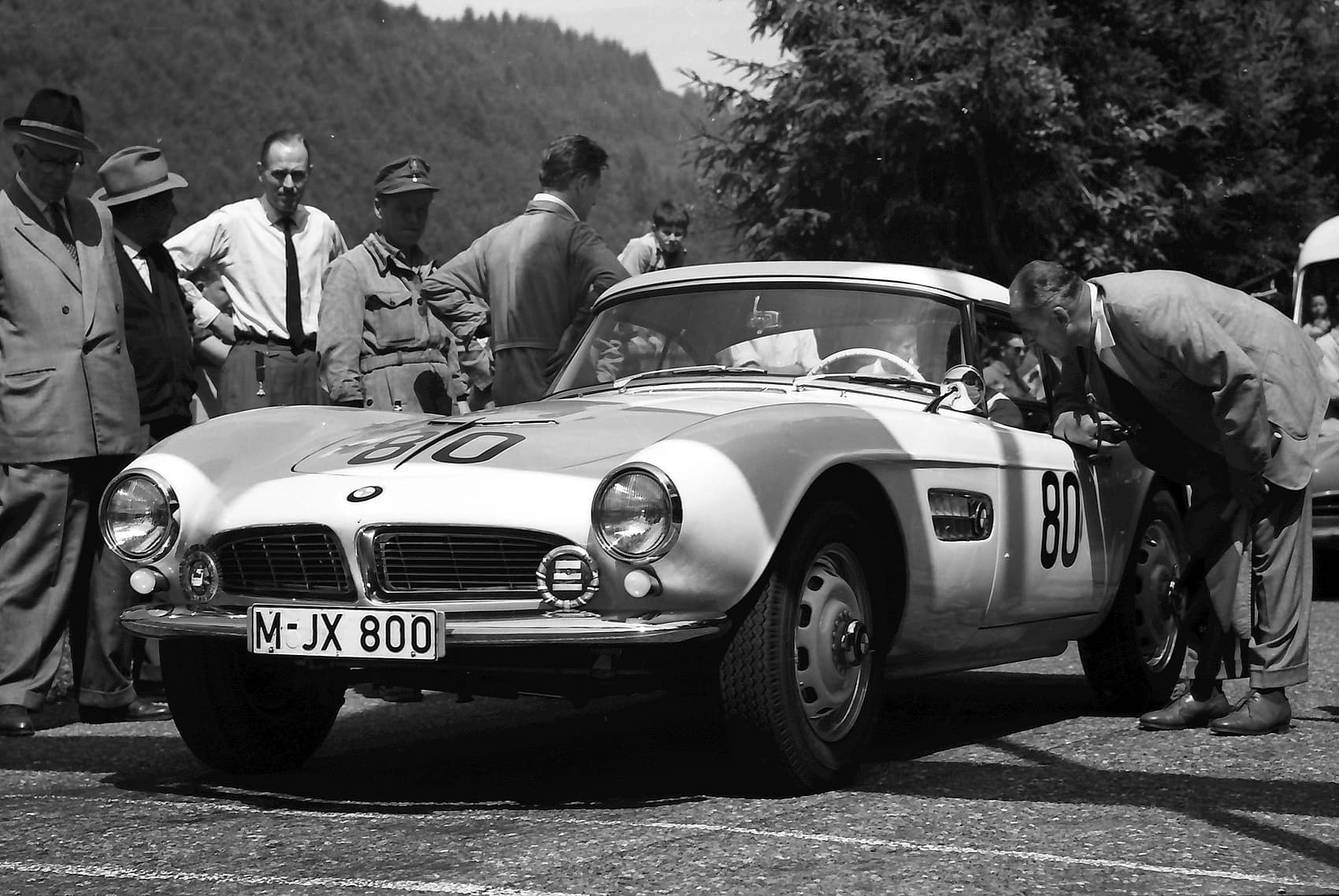
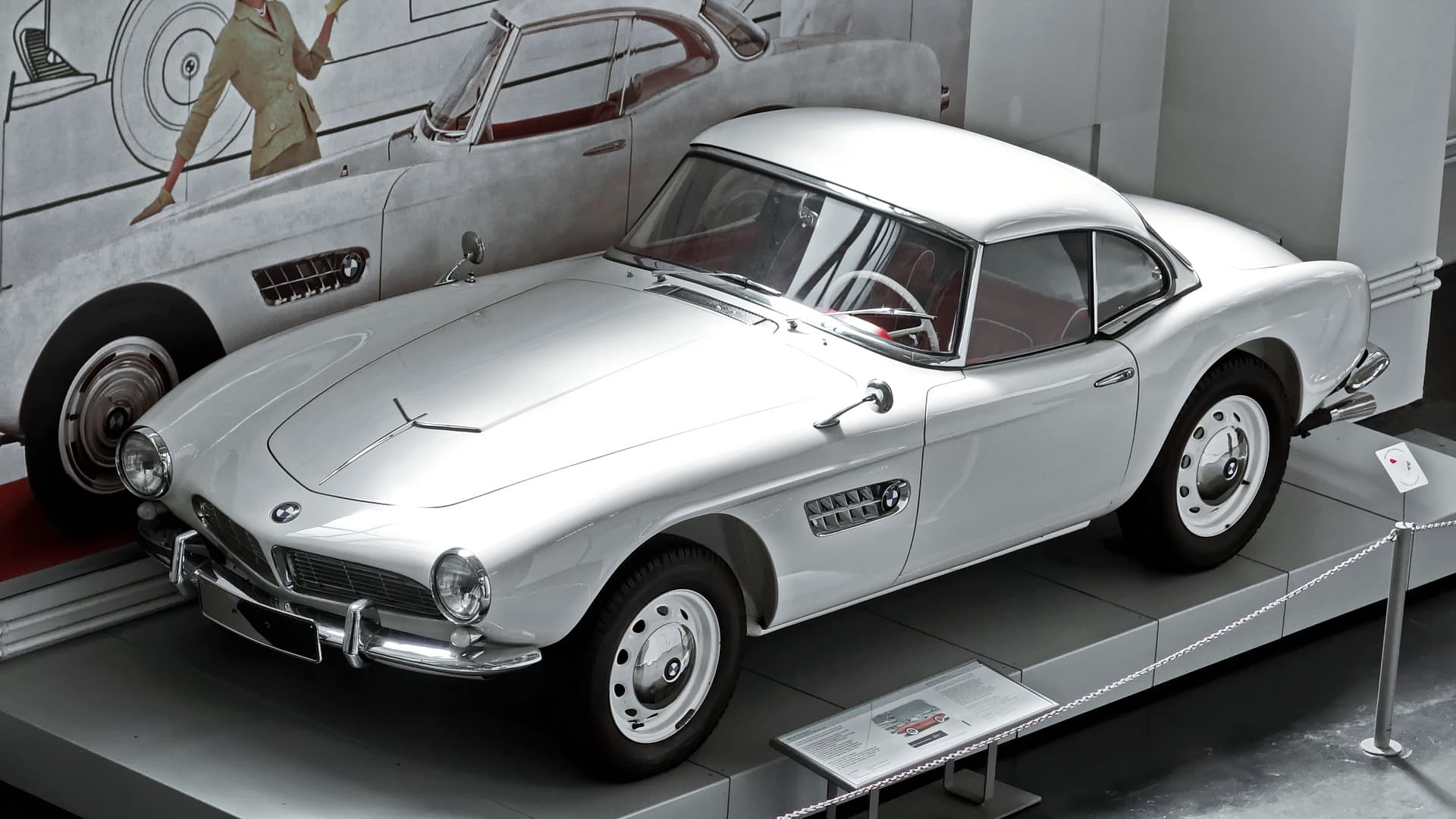
The best-known 507 was BMW's own before it was Elvis Presley's: a white works car, registered M-JX 800, that Hans Stuck drove up hill climbs in the summer of 1958 and BMW sold to a Frankfurt dealer that December. Elvis's car has its own page. The others here are a world champion's car, BMW's works cars in the mountains, two chassis that famous designers had rebodied, the first cars of all, and the actors and royals who owned one, or are said to have. Each car with a record of its own has a card below.source 1source 2
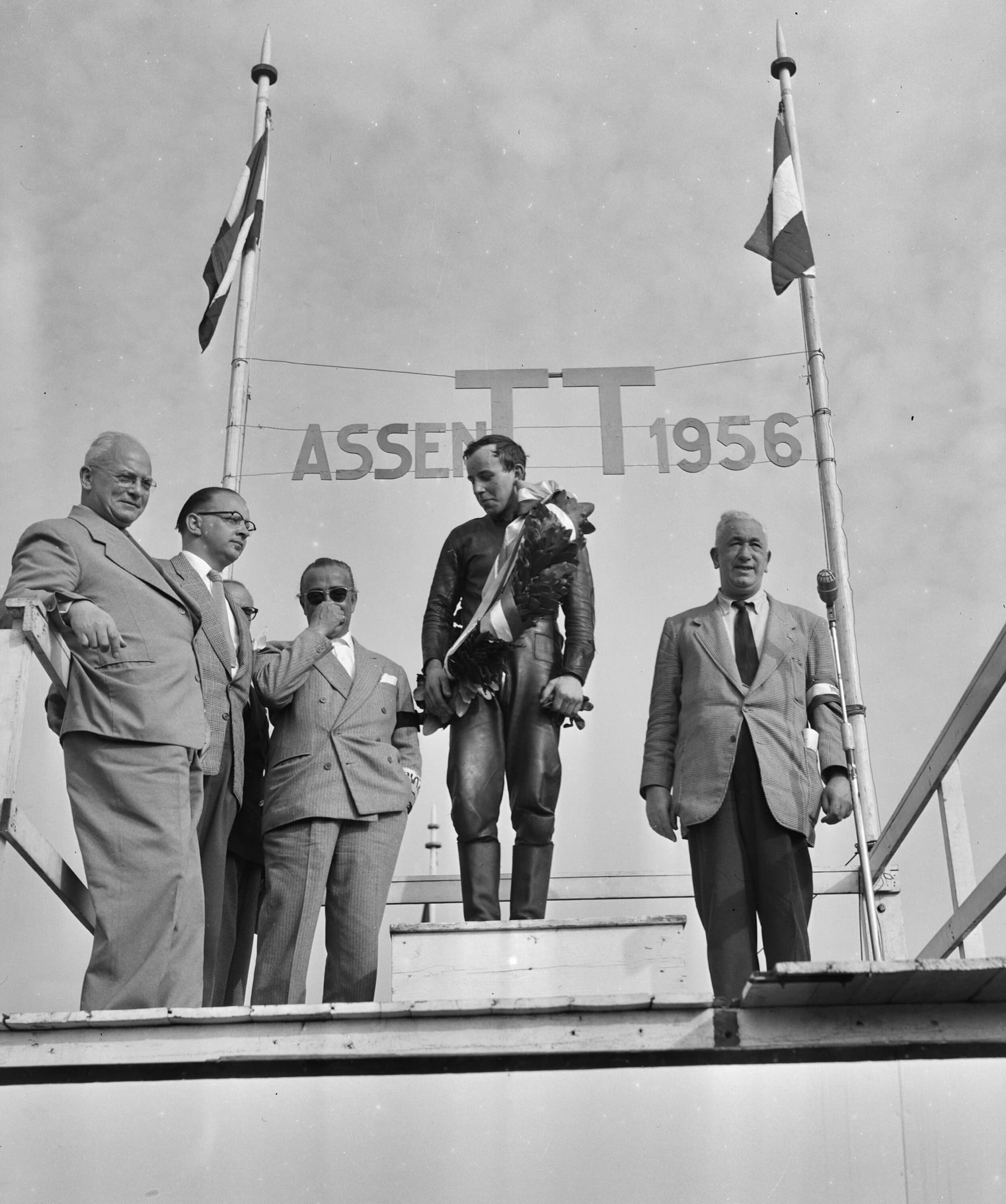
John Surtees won the 500 cc motorcycle world championship for MV Agusta in 1956, and the 507 was his prize. In his own account, given to Automotive Engineering International in 2000, Count Domenico Agusta "said he wanted to give me something as an extra prize for winning. I told him I would think it over. Soon after I saw a 507 at the Hockenheim race track, drove it, and told the Count that was what I wanted." Motor Sport's Earls Court guide of October 1959 noted: "World motor-cycling champion John Surtees also owns one."
He used it to travel between MV Agusta at Gallarate and his home in England. "We went over Alpine passes like the Simplon in those days before a tunnel. The 507 was great on mountain roads, but the brakes got a little hot," he said in 2000. Dunlop was then developing disc brakes for the 507's front wheels; Surtees offered to help and had discs fitted to all four wheels of his car, and its engine was given more power. He had owned it for 43 years by then, and said of the 507s:
Each was like a hand-built car—something special. It still is.
Surtees kept the car until he died in 2017, and his family sold it in 2018.source 3source 4source 5source 6source 7
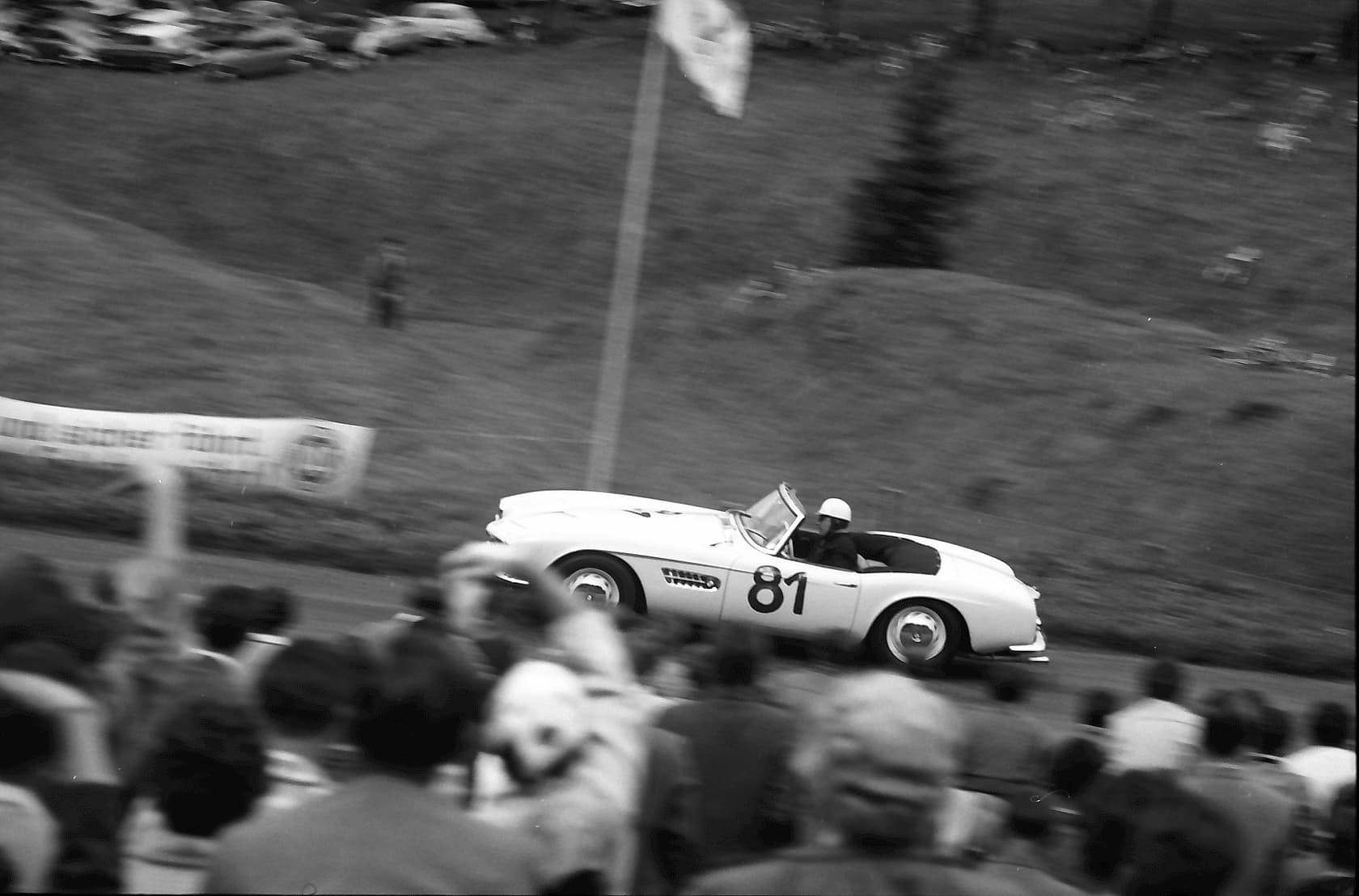
Hans Stuck, Auto Union's Grand Prix driver of the 1930s and the "Bergmeister" of the mountain climbs, began his time with BMW in 1957 and took class wins in the 507, Motor Sport recorded. BMW raced it on hills, as Lange explains:
Due to its relatively high weight for a sports car and its limited engine output, the BMW 507 was not suitable for circuit racing. BMW chose instead to concentrate on hillclimbs, in which the car had a good chance of winning the GT class.
In 1958 Stuck drove the white works car M-JX 800, chassis 70079, and won his class at Rossfeld near Berchtesgaden on 11 May, at Schauinsland near Freiburg on 27 July, in a time of 17 minutes 5.2 seconds, and at Ollon-Villars in Switzerland on 31 August. Behind him at Rossfeld and Schauinsland came Theo Geither in a Mercedes-Benz and Helm Glöckler, a former Porsche works driver, in his family firm's 507; Glöckler raced it in five hill climbs in 1958 and 1959 and finished behind Stuck every time, Bimmer reported.
For 1959 BMW gave Stuck a second works car, chassis 70145, painted Japan Red and prepared for more performance by Alex von Falkenhausen. He won at the Wallberg above the Tegernsee on 9 May, won the GT class over 2,000 cc at Rossfeld on 14 June, and finished ahead of Glöckler again at Schauinsland on 26 July. At the Wurzen Pass near Villach in Austria, on a wet 4.6 km (2.9 mile) course not long after the Italian Grand Prix that September, he was sixth overall in 3 minutes 2.0 seconds; J. Greger's Porsche Carrera was fastest of the GT cars in 2 minutes 59.7 seconds. Denis Jenkinson, who drove in the event, reported that "Greger drove his hot Carrera superbly to beat Stuck's works prepared 507 B.M.W., and d'Orey's 250 GT Ferrari."
BMW Group Classic also records a 507 in the 1957 Mille Miglia: No. 525, driven by the Venezuelan Enrique Muro in the class for sports cars over 2,000 cc, which did not finish.source 8source 9source 10source 11source 12source 13source 14
Raymond Loewy, the industrial designer, saw the 507 at the Paris Salon of 1956 and could buy a chassis only after Albrecht Goertz, who had worked in his studio, asked Fritz Fiedler at BMW for one. Chassis 70024, completed in Munich on 28 February 1957, went to the coachbuilder Pichon et Parat at Sens. Its closed two-seater body was plastic, by BMW's accounts. Denis Jenkinson saw it at the Paris Salon that October:
Two real Paris Salon "specials" were the Raymond Loewy-designed tiny two-seater coupe on a B.M.W. 507 chassis and the Oldsmobile Golden Rocket 88. The Loewy creation, in cream colour, is smooth in the extreme, though shaped more to blend with household components such as sewing machines, smoothing irons, radio sets or cocktail cabinets, rather than other motor cars.
The body was so close-fitting that the spare wheel had to ride inside it, behind the seats. BMW's board considered taking action and decided not to, "since there is nothing to stop anyone fitting a special body to a chassis they have already purchased from us", in the record Karlheinz Lange quotes. Loewy drove the coupé himself until an accident in 1958, after which it was rebuilt. Loewy gave it in 1962 to the Natural History Museum of Los Angeles County; in 2013 it was in the Petersen Automotive Museum's collection, which showed it at Pebble Beach.source 15source 2source 16
The Italian designer Giovanni Michelotti built his 507 for no client. BMW Group Classic's account:
Struck by the appearance of the BMW 507 and acting on his own initiative, Michelotti ordered a 507 chassis from the Munich-based manufacturer and sculpted a body for it which he would later present at the Turin Motor Show in May 1959.
Martin Buckley of Classic & Sports Car found "no suggestion" that BMW or any customer commissioned it. Michelotti's first drawing is dated 25 July 1957. Chassis 70184 reached Italy in 1958, through BMW's Italian importer; Sergio Scaglietti built the body and it was mounted at Alfredo Vignale's works in Turin, with front disc brakes, electric windows, "by G Michelotti" on the nose and the instruments in a single oblong pod. It was shown at the Turin show in 1959, in May by BMW's account. Buckley sees its tail again in Michelotti's Triumph TR4 of 1961.
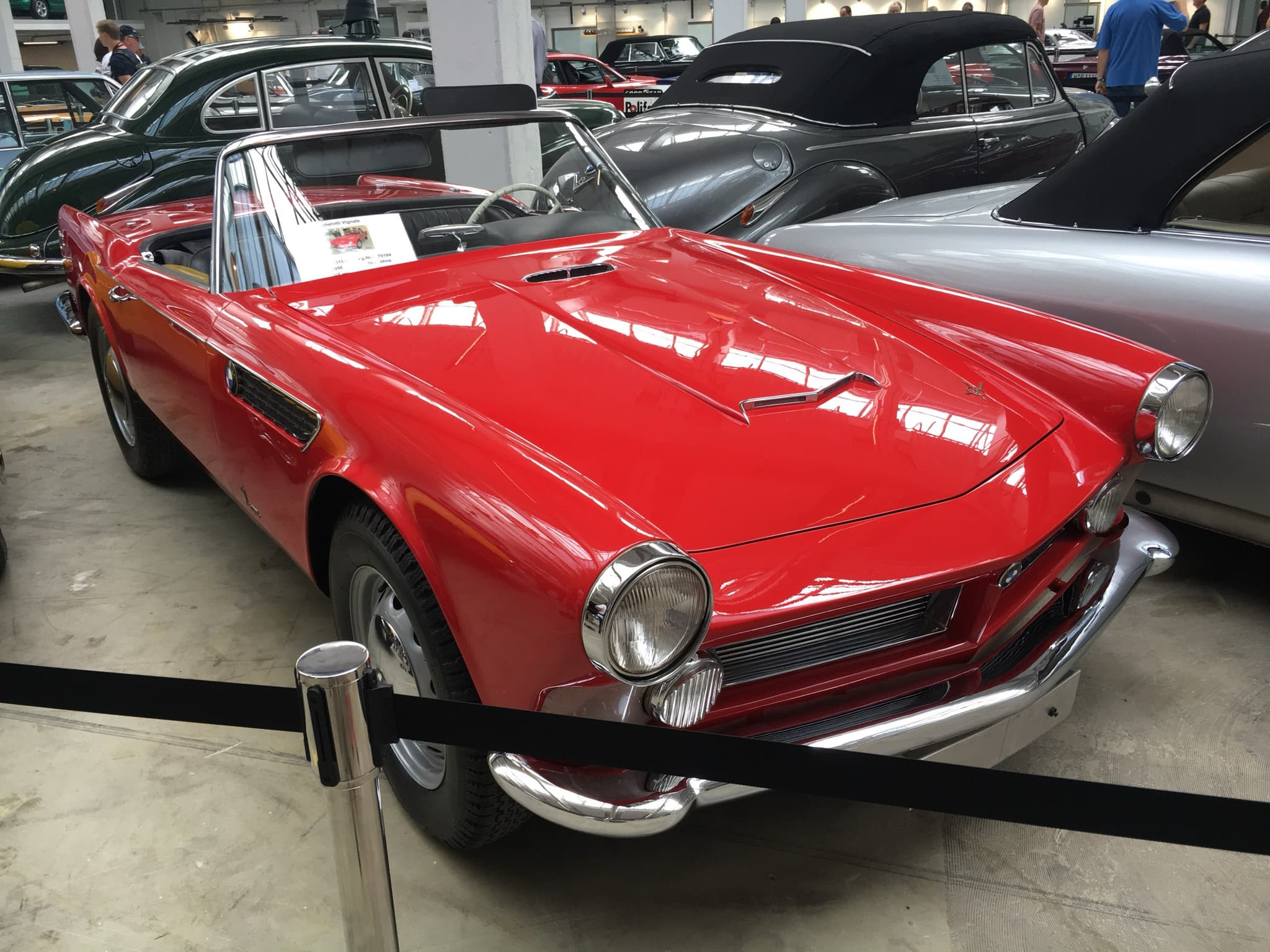
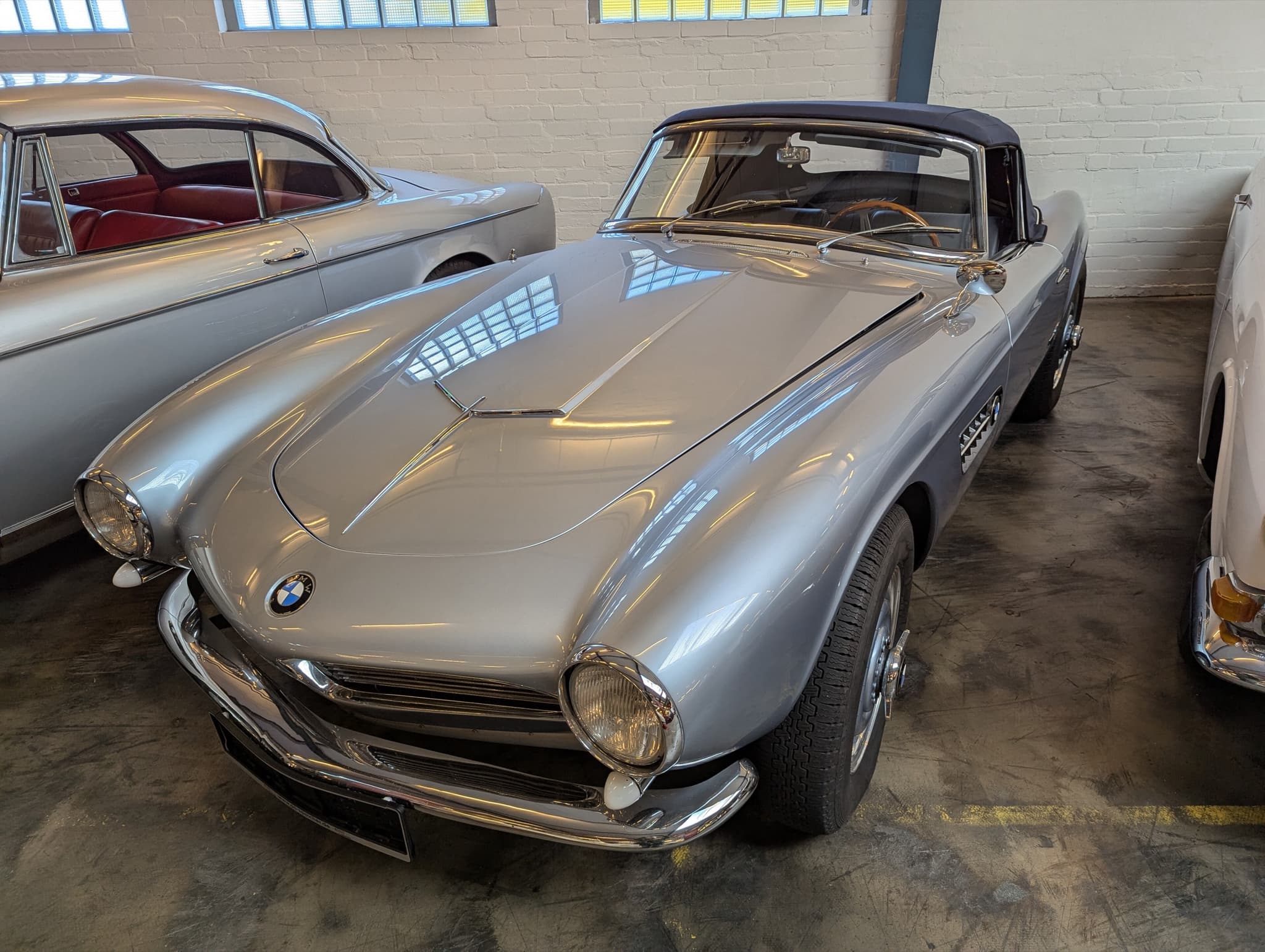
The car then disappeared from view for about 25 years. It passed to an American collector in 1986 and was restored, and in 2001 it joined the Blackhawk Collection in California. BMW Mobile Tradition, now BMW Group Classic, bought it in 2005, repainted it and rebuilt its engine, and calls it the BMW 3200 Michelotti Vignale; in 2015 it stood in the BMW Museum's exhibition for the 507's sixtieth year, "Family affairs".source 14source 17source 2
The 507's first chassis numbers belong to its prototypes. The first, 70001, was Ernst Loof's car of 1954, built at BMW's branch at the Nürburgring on a shortened 502 chassis with a body by Baur of Stuttgart. It won a gold medal at the Bad Neuenahr concours that September, but Max Hoffman judged it unsaleable in America and BMW chose Goertz's design instead; Loof's car stayed a one-off and, after years in Italy, was back in Germany by 1967. Chassis 70002 was one of the first two cars to Goertz's design, built in 1955 and shown at the Frankfurt show that September, the 507's public debut; BMW's own account of 2005 has it among the two cars Goertz showed privately in New York that June. The first series car was completed on 11 December 1956, by Karlheinz Lange's research as Bimmer reported it in 2009. The history tells how the two designs came about.source 2source 14source 16source 10
BMW said in 2016 that "Celebrity owners like Alain Delon, Ursula Andress and John Surtees contributed to the image of the roadster as a status symbol." The evidence for each name differs. Surtees's ownership rests on his own account and MV Agusta's letter, and Elvis Presley's on BMW's archive, which found the insurance proposal for his car.
Ursula Andress owned chassis 70192 from 1963, the Stone Grey car BMW had shipped new to Fadex in New York on 25 May 1959. "I loved the car and drove it almost every day, around the ranch and to the city, everywhere," she told Bimmer in 2013. It soon had new bumpers and her pictures on the dashboard, and during her ownership a Ford 289 V8 replaced its engine. Whether Elvis gave it to her is answered on his car's page.
David Carradine bought chassis 70138, delivered new to the Imperial Garage in Paris in May 1958, while he was starring in the television series Kung Fu between 1972 and 1975, according to the car's next owner. Three more names rest on a single source each: Alain Delon is named by BMW among the 507's celebrity owners, in 2016, and Prince Rainier III of Monaco and the King of Morocco are named by Bimmer, in 2013.source 1source 2source 10
In the summer of 1958 BMW lent its works car M-JX 800 to the Bavaria film studios for the musical comedy Hula-Hopp, Conny, with Cornelia Froboess and Rudolf Vogel; it was one of two 507s in the film, released in 1959.
On 2 April 2015 Germany issued a 145-cent stamp of the 507 in its series "Klassische deutsche Automobile", designed by Thomas Serres, as a pair with a stamp of the Mercedes-Benz 220 S (W 111).source 1source 10source 18
When BMW Group Classic showed Elvis Presley's car unrestored in 2014, it said the car would stay in the BMW Museum in Munich once it was restored, and Bimmer expected in 2016 that it would also be shown at the BMW Zentrum in South Carolina. Photographs taken in January and May 2025 show it in the museum in a room of its own. BMW Group Classic has owned Michelotti's car since 2005 and showed it in the museum's exhibition of 2015. Pebble Beach gave the model a class of its own in 2013, when six cars came, among them Loewy's coupé and Michelotti's car.source 19source 20source 9source 14source 2
Built 1954
Survives
Built 1955
Whereabouts unknown
Built 1957
Survives
Survives
Whereabouts unknown
Built 1959
Survives
Built 1958
Survives
Built 1957
Survives
Every source the site cites is on the sources page.